#Personal Growth OS
AI coaching platform with a RAG engine
##Problem
Generic LLM coaching advice isn't grounded in any real curriculum, and a naive integration between a mobile client, a business-logic backend, and a separate Python inference service tends to break the moment one of those pieces is slow or unavailable. Personal Growth OS grounds every response in a curated knowledge base via retrieval-augmented generation, and wraps the Java-to-Python bridge in circuit breakers, retries, and timeouts so a failure in one service degrades gracefully instead of cascading.
##Architecture / How it works
The Flutter client talks to a Spring Boot modular monolith, which includes an AI gateway layer built on Resilience4j — circuit breaker, retry, and timeout policies protect the Java API from instability in the downstream Python service. That gateway calls a FastAPI RAG engine, which serves DeepSeek LLM responses grounded in a curated knowledge base stored in Qdrant, alongside PostgreSQL and Redis.
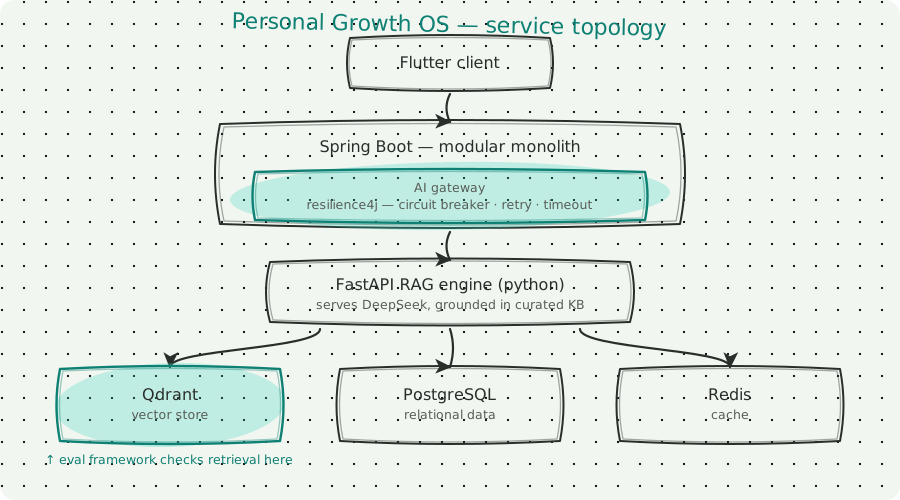
fig. 1 — service topology, sketched on a whiteboard
The knowledge base itself comes from a separate ingestion pipeline: raw transcripts go through spaCy cleaning, semantic chunking, LLM-based extraction, a validation step, and finally vector indexing into Qdrant.
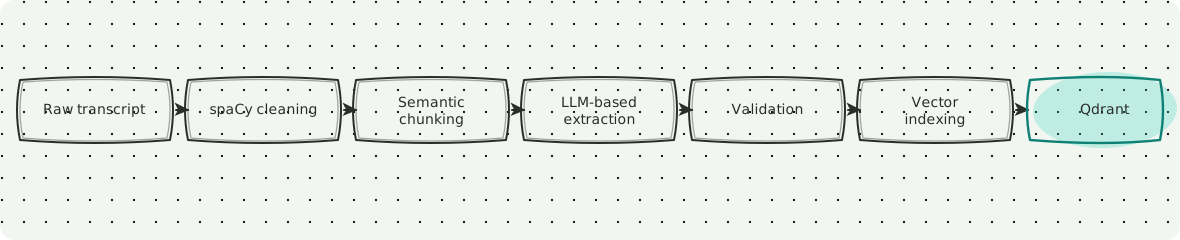
fig. 2 — transcript-to-knowledge-base pipeline
##Tech Stack
##Key Engineering Decisions
The eval framework is the differentiator here — retrieval quality is measured against human-labeled queries and used to drive measurable before/after improvements, rather than tuning the RAG pipeline by feel.